

123 Creative Lane London, SW1A 1AA United Kingdom
Your ecommerce store doesn’t need more random traffic.
It needs more customers.
At GAVEXA, we build and manage performance advertising campaigns designed to turn attention into product views, product views into purchases, and purchases into sustainable ecommerce growth.
Across Facebook, Instagram, TikTok, Snapchat, and other relevant paid channels, every campaign is built around one objective:
Sell more products — profitably.
More Revenue Is.
Thousands of people visiting your store means very little if they don’t buy.
That’s why we don’t judge ecommerce advertising by clicks, impressions, or engagement alone.
We focus on metrics connected to real business performance:
Purchases
How many customers are actually buying?
Revenue
How much money are your campaigns generating?
ROAS
How much advertising revenue are you generating for every amount spent?
Cost Per Purchase
What does acquiring each order actually cost?
Conversion Rate
How efficiently is your store turning visitors into buyers?
Average Order Value
How much does the average customer spend per order?
Customer Acquisition Cost
How much does it cost your business to acquire a new customer?
Because successful ecommerce advertising isn’t about buying traffic.
It’s about buying growth.

Let’s Give Them a Reason to Buy.
Your potential customers are discovering products every day.
On Instagram.
On Facebook.
On TikTok.
On Snapchat.
The opportunity is massive.
But so is the competition.
Your ad has seconds to answer three questions:
Why this product?
Why your brand?
Why should I buy now?
GAVEXA builds advertising strategies designed to answer those questions quickly — and move potential customers from discovery to purchase.
Different platforms create different buying behaviors.
That’s why we don’t copy and paste the same campaign across every channel.
We build the strategy around your products, audience, creative style, customer journey, and growth stage.
Facebook remains a powerful environment for reaching potential customers, retargeting interested shoppers, and building scalable ecommerce campaigns.
We structure campaigns around:
Your ads shouldn’t simply introduce your brand.
They should move customers closer to checkout.
Instagram is where visual discovery can become purchase intent.
We create ecommerce campaigns designed to make products desirable before asking customers to buy.
Advertising can include:
The objective?
People don’t come to TikTok to watch traditional commercials.
That’s exactly why traditional-looking ads often struggle.
Winning TikTok ecommerce creative needs to feel native, fast, interesting, and authentic.
We develop advertising concepts around:
Because on TikTok, the creative isn’t just part of the campaign.
Snapchat can be a powerful channel for brands targeting mobile-first and younger audiences.
We develop fast, visually engaging advertising experiences designed to create product interest and move customers toward purchase.
Campaigns may focus on:
Customers rarely buy because an ad says:
“Shop Now.”
They buy because something in the advertisement gives them a reason.
Maybe it solves a problem.
Makes something easier.
Looks better.
Saves time.
Feels exclusive.
Has strong social proof.
Offers exceptional value.
Or simply creates desire.
That’s why our ecommerce advertising strategy starts with understanding why people should want the product, not just what the product is.

Imagine you’re selling the same product with five different advertisements.
Ad 1 focuses on the problem.
Ad 2 demonstrates the product.
Ad 3 uses a customer testimonial.
Ad 4 focuses on the offer.
Ad 5 focuses on the transformation.
Same product.
Completely different reasons to buy.
That’s creative strategy.
And it’s one of the biggest drivers of ecommerce advertising performance.
We continuously test different:
Because you don’t need one perfect advertisement.
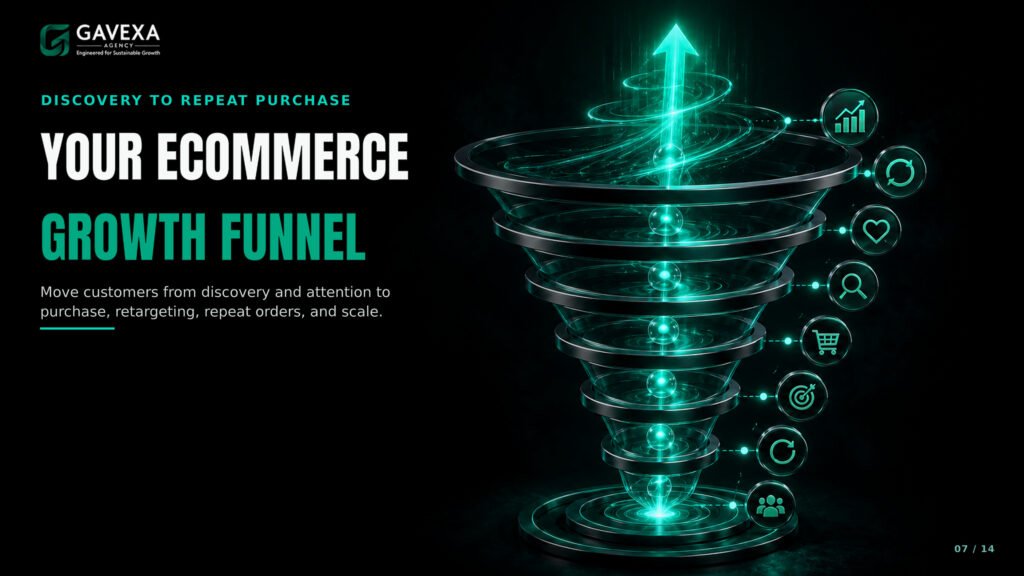
High-performing ecommerce advertising doesn’t depend on one campaign.
It requires a complete customer journey.
01
Introduce your product to potential customers who may not know your brand yet.
02
Use strong creative to stop the scroll.
03
Communicate why the product matters and why the customer should want it.
04
Move interested customers toward your product or collection pages.
05
Reduce friction and give customers a compelling reason to complete their order.
06
Bring back people who viewed products or started shopping but didn't purchase.
07
Reconnect with previous customers and create opportunities for additional revenue.
08
Put more budget behind the campaigns, audiences, and creatives producing stronger business results.
Your ecommerce brand can’t grow by selling only to people who already know you.
You need a consistent flow of new potential customers.
Our prospecting campaigns are designed to introduce your products to people with the potential to become buyers.
Depending on the platform and available data, strategies can involve:
We continuously evaluate where purchases are coming from and shift strategy based on performance.
Someone visits your product page.
Looks at the product.
Checks the price.
Maybe even adds it to their cart.
Then leaves.
Was the opportunity lost?
Not necessarily.
Retargeting allows us to reconnect with shoppers who have already demonstrated interest.
Campaigns can target people who:
The message can then change according to where they are in the buying journey.
Many shoppers won’t purchase during their first visit.
They may get distracted.
Compare prices.
Wait until payday.
Need more information.
Want to check reviews.
Or simply forget.
We build retargeting strategies designed to bring high-intent shoppers back to the store and give them another opportunity to complete their purchase.
That might involve:
The objective isn’t to chase everyone.
It’s to reconnect with people who have demonstrated meaningful intent.

Modern ecommerce advertising has changed.
Targeting matters.
Campaign structure matters.
Tracking matters.
But increasingly, the difference between average campaigns and strong campaigns comes down to creative.
GAVEXA develops ecommerce creative strategies built around performance.
Depending on your products, this can include:
Show people how the product works.
Start with the customer’s problem and position your product as the solution.
Modern ecommerce advertising has changed.
Let real customer experiences reduce hesitation.
Show the difference your product can create where appropriate.
Give customers a financial or promotional reason to buy now.
Show why your product stands apart.
Sell the outcome, not just the features.
Show how the product fits into your customer’s life.
Turn the product experience into part of the advertising.
A beautifully produced video is useless if nobody watches it.
That’s why the opening hook is critical.
We test different creative hooks designed to earn attention before selling the product.
Examples of creative structures include:
The objective is not to make ads that look impressive in a portfolio.
The objective is to create ads customers actually respond to.

Your ad does not complete the sale.
Your store does.
A customer can love your advertisement and still leave because of:
That’s why we look beyond the advertising dashboard.
We evaluate the customer journey from:
Because improving advertising while ignoring the store can leave significant revenue on the table.
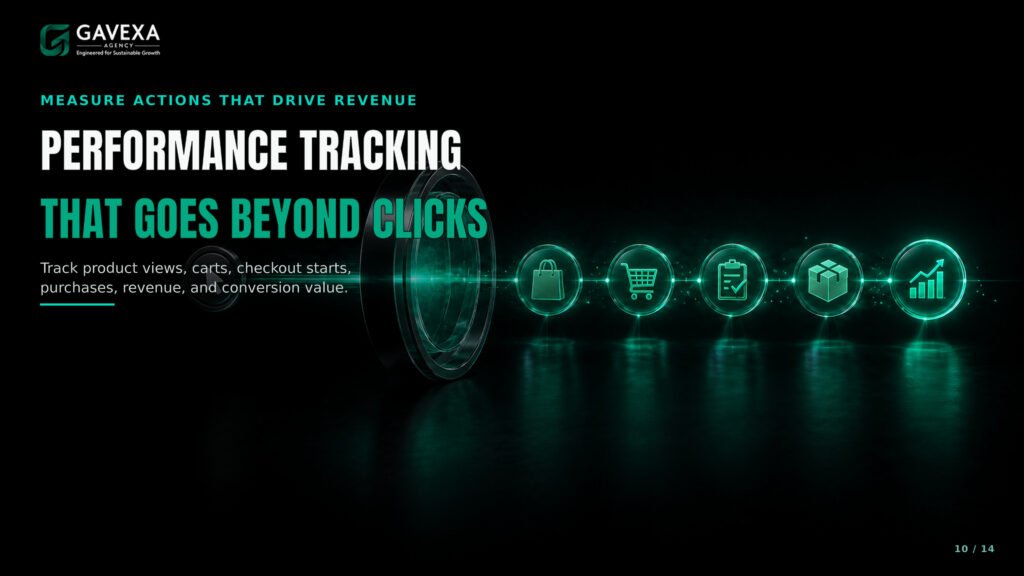
To optimize ecommerce campaigns effectively, we need visibility into customer actions.
Depending on the platform and ecommerce setup, tracking may include:
Better tracking gives us better information.
Better information leads to better advertising decisions.
For stores with multiple products, catalog advertising can create powerful opportunities.
Instead of manually creating an advertisement for every product, ecommerce advertising platforms can use product feeds and catalogs to dynamically show relevant products to different shoppers.
This can support:
The right customer sees the right product at the right stage of their journey.
A high ROAS screenshot looks impressive.
But ecommerce growth is more complicated than one metric.
Imagine:
Product A generates a 5X ROAS but has very low margins.
Product B generates a 3X ROAS but produces substantially more profit.
Which campaign is actually better for your business?
That’s why we try to understand the economics behind your ecommerce store.
Where possible, we consider:
Because the ultimate goal isn’t impressive reporting.
Getting more customers is one way to grow revenue.
Getting every customer to spend more is another.
Your advertising and ecommerce strategy can support higher order values through:
When the economics of each order improve, you often gain more room to scale advertising.
Your cheapest future sale may come from someone who already purchased from you.
For relevant ecommerce businesses, previous customers can become valuable advertising audiences.
Campaign opportunities can include:
The relationship shouldn’t end after checkout.
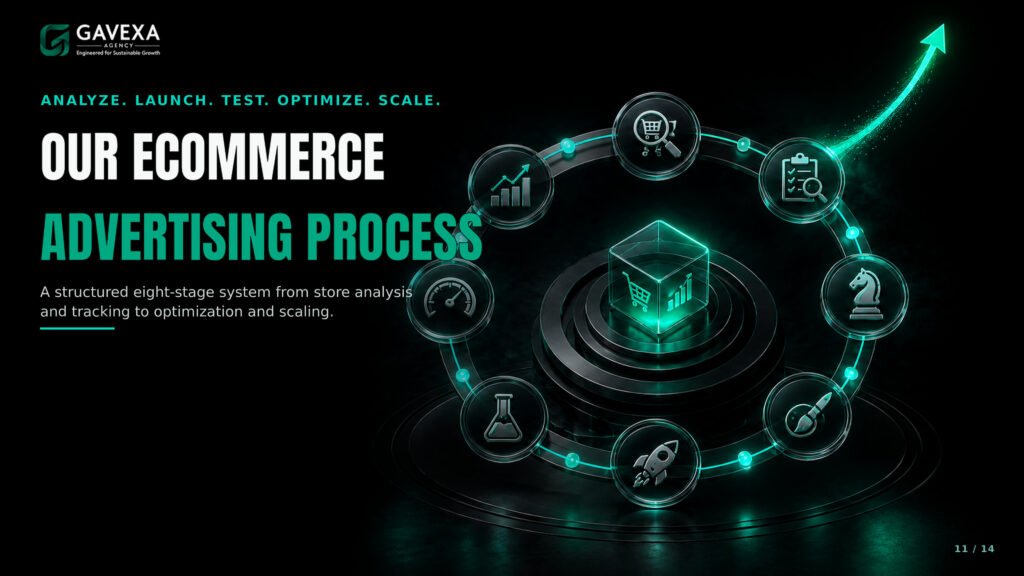
We understand:
We assess whether the right customer actions are being captured so campaign decisions can be based on meaningful data.
We define:
We identify the product angles most likely to create attention, desire, and purchasing intent.
We launch structured campaigns designed to collect useful performance data.
We continuously test elements such as:
Budgets and strategy are adjusted according to what the data tells us.
When we identify campaigns with strong and sustainable economics, we look for opportunities to increase revenue while protecting efficiency.

Your campaign is generating sales.
You increase the budget.
Suddenly performance drops.
Sound familiar?
Scaling isn’t simply increasing daily spend.
As campaigns grow, you can face:
That’s why scaling requires a system.
More creative.
More testing.
More audience opportunities.
Better conversion rates.
Better economics.
Yesterday’s winning ad won’t necessarily be next month’s winning ad.
As more people see the same creative repeatedly, performance can decline.
That’s why we continuously look for opportunities to refresh:
Instead of waiting for winning campaigns to die, we work toward building a pipeline of new creative opportunities.
Increasing spend without understanding performance is not scaling.
It’s gambling.
Before pushing budgets, we look at signals such as:
Then we make informed decisions about where additional budget has the strongest opportunity.
GAVEXA can build advertising strategies for ecommerce businesses selling products across categories such as:
Whether you sell one hero product or hundreds of SKUs, the strategy should reflect how your customers actually buy.
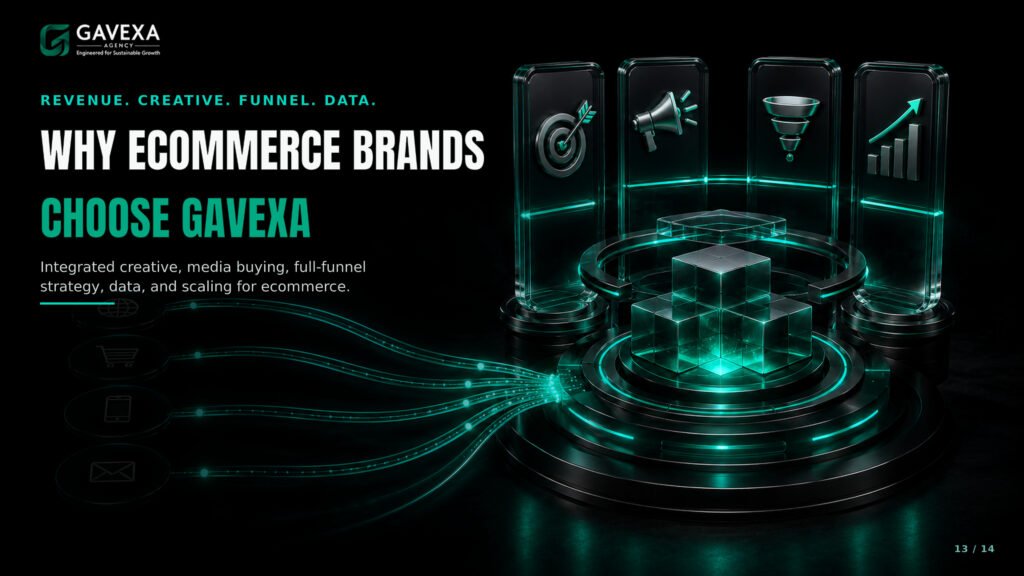
Our campaigns are structured around actions connected to sales.
Strong media buying can’t rescue weak creative.
We approach both together.
From first impression to abandoned cart retargeting, we think about the complete customer journey.
Campaign decisions are guided by performance data and ecommerce economics.
We identify the advertising channels that make sense for your products and customers instead of spending everywhere.
We don’t just ask how to generate today’s purchases.
We ask what needs to happen to generate more tomorrow.
Every day, potential customers are discovering products online.
Some will buy from your competitors.
Some haven’t discovered your brand yet.
And some already visited your store but never completed their order.
The right ecommerce advertising system helps you reach all three.
Let’s build an advertising strategy around your products, customers, margins, and growth goals.
Ecommerce advertising is the use of paid digital campaigns to promote products and drive measurable actions such as product views, add-to-carts, checkouts, and online purchases. Campaigns can run across platforms such as Facebook, Instagram, TikTok, Snapchat, and other relevant advertising channels.
There is no single platform that is best for every ecommerce store. The right channel depends on your products, audience, price point, creative assets, target market, customer behavior, and growth objectives. GAVEXA builds the platform strategy around your specific business.
Yes. GAVEXA creates and manages ecommerce advertising strategies across Facebook and Instagram, including prospecting, retargeting, purchase campaigns, product-focused creative, and catalog-based advertising where appropriate.
Yes. TikTok can be particularly effective for products that can be demonstrated visually or supported by strong short-form creative. We develop campaign and creative strategies according to the product, audience, and business objective.
Yes. Snapchat can be included where its audience and advertising opportunities align with your products and target market.
There is no universal ROAS target. A healthy target depends on product margins, operating costs, shipping, discounts, average order value, repeat purchase behavior, and other business economics. A lower ROAS can sometimes produce more profit than a higher ROAS depending on the business model.
Advertising budgets should be based on your business economics, product demand, target market, customer acquisition cost, growth goals, and available testing budget. We prefer to make budget decisions based on data rather than selecting arbitrary spending levels.
Campaigns can begin producing traffic and purchases after launch, but sustainable performance requires data, creative testing, optimization, and enough conversion activity to evaluate what works. Results vary significantly between products, markets, and stores.
No responsible advertising agency can guarantee a specific ROAS or sales volume because performance is influenced by many factors including demand, competition, pricing, product-market fit, website experience, inventory, offers, and customer behavior. GAVEXA focuses on measurable testing, optimization, and profitable growth.
Reliable tracking is highly valuable for ecommerce advertising because it helps measure actions such as product views, add-to-carts, checkouts, purchases, and revenue. The exact tracking setup depends on your ecommerce platform and advertising channels.
Where the appropriate platform tracking and audience requirements are available, retargeting campaigns can be created for high-intent shoppers such as product viewers, cart users, or people who started checkout but didn't complete their purchase.
Yes. Ecommerce advertising campaigns can be built for Shopify stores, including conversion tracking, product catalog strategies, retargeting, and performance campaigns depending on the store's setup.
Yes. We can develop paid advertising strategies for WooCommerce stores and structure tracking and conversion campaigns according to the website's technical setup.
Our ecommerce advertising approach can include creative strategy, advertising concepts, hooks, messaging, UGC-style directions, product-focused content ideas, and testing plans. The exact level of creative production can be defined within your selected service package.
Yes. We can review existing campaigns and identify opportunities across account structure, creative, audiences, product performance, tracking, retargeting, customer journey, and budget allocation.
Ecommerce retargeting involves advertising to people who have already interacted with your brand, such as website visitors, product viewers, cart users, social media engagers, or previous customers. The objective is to move interested shoppers closer to purchase or encourage repeat purchases.
Our team will answer all your questions. we ensure a quick response.
Copyright © 2026 All Rights Reserved.